Delivered
Shared services work management
A shared work management platform for 90+ finance staff: current work items, consistent statuses, persistent notes, and automated reporting in one place.
- Context
- Shared services finance
- Period
- 2016 - 2020
- My role
- Senior Data Analyst (infrastructure owner)
- Stack
The problem
The platform served more than 90 finance staff in shared services. It brought daily work, status updates, notes, and management reporting into a common system.
The shared services organization managed media buys in Prisma, whose data lives in a mainframe suite (DDS). To get daily work items, each associate logged into a media-type-specific toolkit and requested a report of open items - the same information, at the same morning hours, requested separately by accounts payable staff. System response during that window was painfully slow; collecting a report export could take up to 90 minutes per person. Every two weeks, the resulting spreadsheets were collected and consolidated by hand - a process two analysts spent the better part of a week completing, fighting inconsistent workbook structures the whole way.
The root problem: identical demand, no shared supply.
The approach
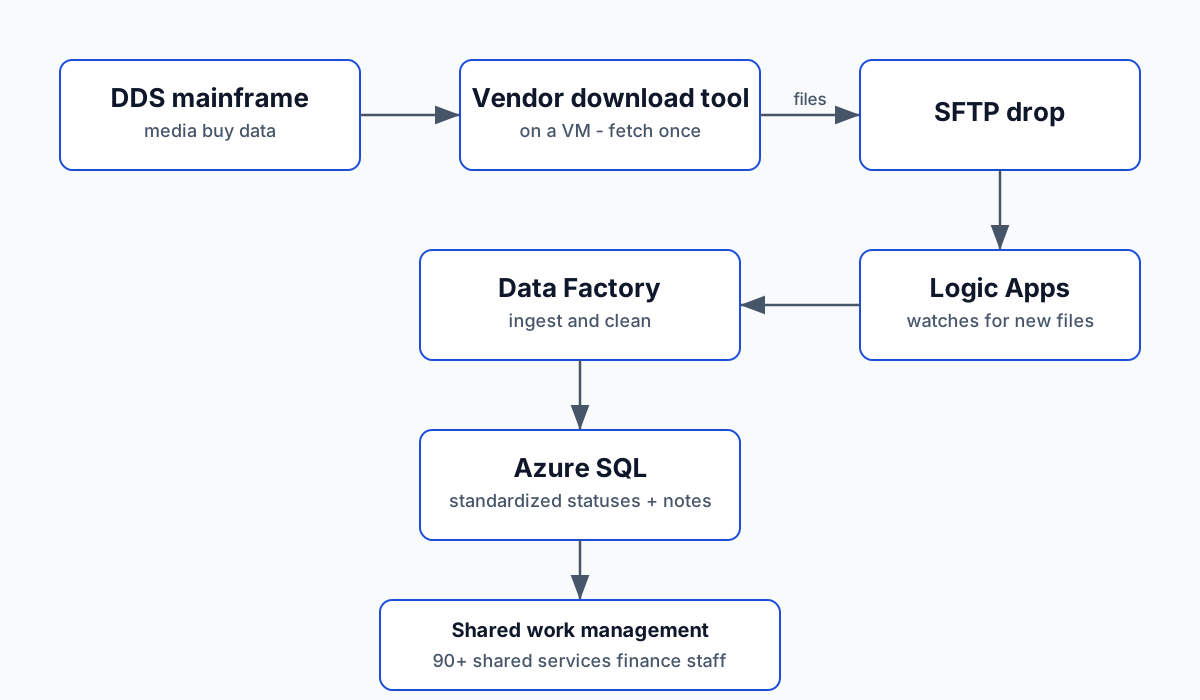
Three layers, each removing one bottleneck:
- Collection, once: working with the vendor, we stood up their legacy report-download tool on a virtual machine. The VM extracts the reports from the mainframe and pushes files to SFTP - the identical report each associate was re-requesting, now fetched once.
- Ingestion and standardization: Logic Apps watched the SFTP location for new files and triggered Data Factory pipelines that loaded and cleaned the data into Azure SQL Server - statuses normalized, history preserved.
- One working surface: an MS Access interface synchronized to the Azure database. Associates worked from current data without requesting anything; the tool enforced standardized status values, collected notes, appended them to new data automatically, and generated the bi-weekly consolidation report that previously consumed two analysts.
The outcome
Report collection moved from a twice-daily scramble to a background process. Standardized statuses and stored notes made the bi-weekly report a generated artifact rather than a hand-built one, and management saw consolidated status in near real time. The platform also became the foundation other finance roles integrated onto.
The outcome is described here as I built and observed it: collection automated, consolidation generated. I am not claiming every individual minute of every workflow disappeared - the point is the pattern, one shared supply replacing dozens of separate report requests.
Tradeoffs and lessons
Find the vendor’s forgotten tool before building a scraper. The automation existed; it needed a VM, a schedule, and someone to own it.
Standardize at ingestion, not at reporting time. Enforcing statuses in the working tool is what made consolidation cheap; normalizing at report time would have replayed the spreadsheet mess forever.
Meet users where they are. MS Access was not fashionable, but it synchronized to Azure SQL and ran on everyone’s desktop - the interface fit the existing desktop workflow.