Mixed: parts delivered, parts in progress
Marketing measurement models
The spend, sales, and attribution models behind marketing mix modeling, CAC reporting, and multi-touch attribution for the organization, with QA monitors and governed metric definitions - and an honest boundary around what is still in development.
- Context
- Commerce analytics
- Period
- 2025 - Present
- My role
- Data Engineer Manager (owner of the measurement models)
- Stack
The problem
Marketing measurement fails quietly. Spend gets double-counted, channels get dropped or scrubbed, attribution windows disagree between vendors, and every analyst’s number is a little different from finance’s. At a multi-channel consumer brand, the models behind marketing mix modeling (MMM), customer acquisition cost (CAC), and multi-touch attribution (MTA) have to agree on definitions before anyone argues about results.
The second, quieter problem is trust over time: when a dashboard number moves, the organization needs to know whether marketing changed or the pipeline did.
The approach
I own the models behind the measurement stack:
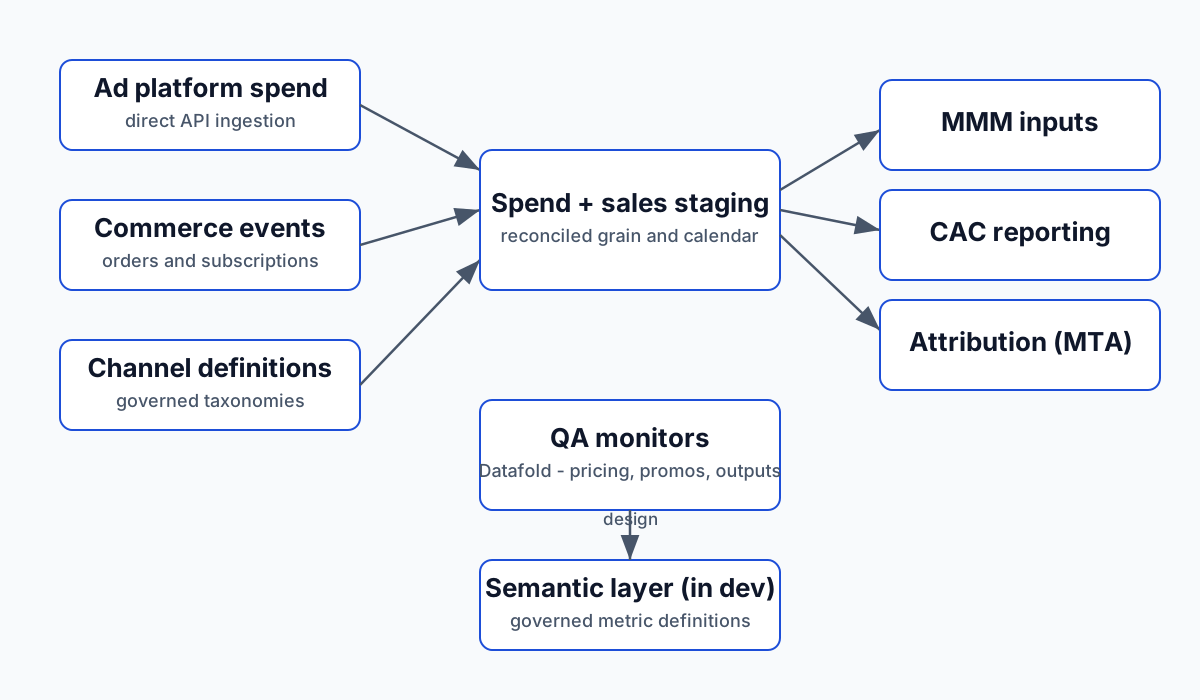
- Spend and sales staging: consistent models over the direct-ingested ad and commerce sources, reconciling channel taxonomies and calendar grain so MMM inputs, CAC math, and attribution see the same reality.
- Channel-level attribution: multi-touch attribution logic including handling of view-through windows, where a partner’s defaults were changed to match how the channel actually behaves.
- QA as a first-class layer: data quality monitors watch pricing, promo codes, and pipeline outputs, to help detect changes that need investigation.
- Governed definitions: I lead the design of governed metric definitions on the dbt Semantic Layer (MetricFlow) so dashboards, forecasting, and AI tooling consume one set of definitions rather than three approximations.
The work shipped and in production includes the MMM input models, the CAC/non-CAC spend split behind product-line reporting, and attribution adjustments. The semantic layer model set is in development, not yet in production, and this case study says so - it is not a completed enterprise semantic-layer rollout.
The outcome
Measurement consumers - the MMM engagement, leadership CAC reporting, and growth attribution - work from shared, QA’d models rather than source-by-source extracts. The QA layer provides a place to investigate changes in source data and model output. The semantic layer design is proceeding jointly with analytics engineering, with the first model set under active development.
Tradeoffs and lessons
Modeling is the easy half; definitions are the hard half. The technical work of staging spend is tractable. Getting an organization to agree on what CAC includes is where the real design effort went.
QA monitors earn their keep during launches. The monitors cover specific data boundaries, including pricing, promotional codes, and API processes; they complement model review.
Say what is not done. Separating shipped measurement work from in-development semantic-layer design keeps the portfolio, the resume, and reality aligned.